Hanukkah: The Feast of Dedication
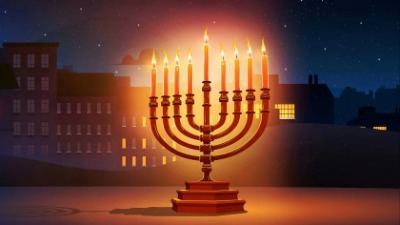 Though the dates vary from year to year, this year's Jewish celebration of Hanukkah (aka the Feast of Dedication) began last Sunday evening (14 Dec) and continues till this coming Monday (22 Dec).
Tragically, the observance of Hanukkah has, for many, quickly come to be identified with the terrorist mass shooting that occurred in the late afternoon of 14th December, during a
Hanukkah celebration at Bondi Beach, Sydney.
What were these thousand or so Jewish people on that Australian beach actually celebrating? This article focuses primarily on the meaning and function of Hanukkah.
The foundation for the Feast comes from the Jewish Talmud and the books of 1 & 2 Maccabees. The latter books are outside both the Jewish and Christian canons. Therefore, although these books are included within a standard Apocrypha, their story is little known to most Gentile believers. We read in John 10:22-23 that Jesus attended the Temple during the Feast of Dedication.
“Then came the Festival of Dedication at Jerusalem. It was winter, and Jesus was in the temple courts walking in Solomon’s Colonnade.”
While Hanukkah remains a Jewish festival celebrating the rededication of the Temple, many Christians view it as an opportunity to explore their faith’s Hebraic roots, appreciate God’s miracles in Jewish history, and focus on the Hanukkah themes of light, dedication and God’s faithfulness.
The historical background
King Cyrus decreed that the Jews should be allowed to return to their own land in order to rebuild the Temple of the Lord (see Ezra 1) and, although many chose to remain (e.g. note the story in the book of Esther), 1st & 2nd Maccabees takes up the story of those who had returned.
many Christians view Hanukkah as an opportunity to explore their faith's Hebraic roots ...
Around 323BC the Greek warrior Alexander the Great, king of Macedonia died aged just 30, and his empire was distributed amongst his generals and their heirs. Around 175-BC one of his descendants, Antiochus IV, inherited the throne. He took the nickname Epiphenes, which means ‘god-manifest’ – which tells us something about his character!
Antiochus determined from the outset to erase Jewish culture and practices. Jews were fiercely persecuted and it became illegal to not follow the state pagan religion of Greek idol worship or to be openly Jewish. As a result, all Temple sacrifices were stopped and Antiochus stripped it of its treasures. It was decreed that the holy site should be deliberately profaned and defiled by anyone wishing to do so.
Eventually, one year, on 15th Kislev (the ninth month of the Hebrew calendar), Antiochus defiled the brazen altar by slaughtering a pig on it. He then erected a full-sized statue of Zeus on the same altar. He rededicated the Temple to Zeus and ordered that everyone should worship him. The death sentence was mandatory for those not complying.
Many Jews were inwardly resolved to stay true to God and the covenant. One such person was Judas, whose followers (called Maccabees) engaged in much successful guerrilla resistance fighting. Over a six-year period they fought many battles where they were outnumbered and could easily have been overwhelmed and beaten. However, each time they acknowledged that their strength came only from God, so they called on His help and He faithfully fought for them and brought a series of great victories.
The enemy was resoundingly defeated and Judas and the Maccabees walked right into the Temple.
Eventually, they resolved to restore the fortunes of their people and make an all-out attempt to recapture the Temple. They gathered all the people together to fast, pray and ask for God’s mercy and compassion to be with them. The enemy was resoundingly defeated, and Judas and the Maccabees walked right into the Temple. They mourned and lamented as they saw how the Temple courts were overgrown, gates destroyed and the priest’s rooms demolished.
Immediately, they set about the work of reclamation and restoration: they tore down pagan altars and a brand-new altar was made from uncut stone and set in place. New vessels were also made, along with an altar of incense, a menorah and a table of shew bread. They burned incense on the altar, set bread on the table and lit the menorah with a very small amount of the consecrated oil that was found in a forgotten store.
The gates were rehung and the city’s walls fortified. The cleansed Temple was rededicated to God on 25th Kislev, with great joy, singing, music and extravagant praise and worship. The whole assembly decreed that the celebration of the rededication should be kept annually on 25th Kislev with great joy and gladness.
The miracle of Hanukkah
The menorah provided the only light in the darkness of the Temple.
“…they searched and found only a single cruse of pure oil... enough to light the menorah for a single day. A miracle occurred, and they lit the menorah with this oil for eight days.” (Talmud, Shabbat 21b)
We are told that the special oil used to light the Temple menorah took eight days to make and consecrate according to the rituals; so God graciously and miraculously caused the light to keep on burning night after night, until the newly prepared oil was available. It is the remembrance of this miracle that, for many, has become the substance of Hanukkah, rather than the act of rededication.
It is the remembrance of this miracle that, for many, has become the substance of Hanukkah, rather than the act of rededication.
However, we must remember that the opposition faced by the Jews at that time was fiercely evil and was not something that could be overcome simply by knowledge of the Torah or tradition. It was the rising up of their inner strength and complete trust in God’s faithfulness to His covenant people that inspired Judas and his followers to stand fearlessly and fight the injustice of their situation. It was their resistance that eventually allowed them to rekindle the flame of Israel as a light to the nations.
“…I will also make you a light for the Gentiles, that My salvation may reach to the ends of the earth.” (Isa 49:6)
The symbolism of the light of the menorah
The Temple in Jerusalem has long gone. As believers it is our bodies that are now the temples of the Holy Spirit – places of His abiding presence (1 Cor 6:19-20). We are also being built together to form a world-wide living temple (1 Pet 2:5).
The outworking of both these things is that we, Messiah’s living body, carry within us the light of the glory of the gospel, which is Jesus (1 Cor 4:4-6). He also instructed us that because we are in Him, we too can affect the spiritual climate and atmosphere by releasing the light of His love wherever we go to whomsoever we meet. This is the ministry of the Holy Spirit through the saints, bringing the light of God into the dark places of the world (Matt 5:14-16).
In this way, we also carry the mandate given first to the Jews to be a light to the Gentile nations (Isa 49:6) and to bring the illumination of the truth of Jesus to the Jews themselves. To sum up then, this light burns inwardly, but its effect causes us to shine outwardly.
To sum up then, this light burns inwardly but its effect causes us to shine outwardly.
In terms of the menorah itself, the base signifies the ‘stump of Jesse’ and the stem the Branch – Jesus – (in the Hebrew
netser (Strong’s Concordance H5342), the new green shoot bringing fresh hope and new life from Jesse’s (i.e. also David’s) ancestral line. Then there are seven cups designed to hold oil, symbolising the light, healing, and everything we need for life that comes from our being ‘in Christ’.
The menorah used in the celebration of Hanukkah has nine branches rather than the usual seven. The number eight represents the eight nights of the miracle and the ninth, the central light, is known as the servant – being the light that is kindled first and from which all the other lights are lit.
To Christians, of course, it speaks of Jesus, who selflessly sacrificed His own life as the servant of God’s purposes for us to have the light of God lit within us through the indwelling ministry of the Holy Spirit.
Rededication
For us to live more fully in this, we must consider the other aspect of Hanukkah – the rededication of the altar – which is, for us, our hearts: to choose to separate from our former ways and wholeheartedly seek a deeper more intimate relationship with God.
What we imagined initially as only a small supply of ‘oil’ can actually keep the inner fire burning and growing far beyond what is normal in the natural.
The miracle of Hanukkah symbolises that once God is invited to step into a given situation, His Spirit’s light is then able to illuminate our spirit, soul, mind and body with His wisdom, counsel and understanding. This enables us to make wise choices.
Success or victory in small things builds faith, which in turn strengthens and fans the little flame into a growing fire. What we imagined initially as only a small supply of ‘oil’ can actually keep the inner fire burning and growing far beyond what is normal in the natural.
The Holy Spirit gives strength, guidance and support to the weary. He also gives the assurance, which grows by faith, to become an inner stronghold – that it is God’s love and He Himself who is our strength, fortress, shield and stronghold, rather than our own abilities.
“He gives strength to the weary and increases the power of the weak.” (Isa 40:29).
Conclusion
Let us then, consider what the challenges of Hanukkah might be for each of us:
-
To stand for truth and resist evil, whatever the outcome for us might be; to bravely fight for righteousness and justice in the face of increasing persecution.
-
To rededicate the altar of our heart; to take time to prayerfully consider what ‘idols’ might be taking a higher priority in our everyday life rather than that of living for and serving God.
-
To pursue a deeper relationship with Jesus; to consider the call to a greater discipleship so that from a place of rest and abiding in Him, we allow His indwelling light to shine out through us to affect the people and communities where He has placed us.
Sarah Winbow, 14/12/2025