Green Fingers in Small Spaces
Using small gardens to produce food
 The risks of an economic meltdown or other major disruptions steadily mount, and many continue to predict major problems ahead. You may, like me, have been inspired by Sarah Winbow’s helpful chronicling of the enacting of her vision to create a smallholding where she could not only grow much of her food, but also to help her neighbours, too, should such a time arise.
However, like me, you may be very much limited to the space (and time) that you have available to grow food.
Yet even a modest attempt to grow some of what you and your family can eat has the potential to lessen the impact of any major food supply issues in the future, especially if you can prepare and practise right away. And now, with food prices being so high, carefully done, fruit and vegetable growing can help to save you money.
But in a limited space, and with a limited budget, it is necessary to make the very most of what you have.
Like me, you may be very much limited to the space (and time) that you have available to grow food.
Some of the advice I might have shared has already been highlighted by Sarah, such as the importance of learning from your mistakes, and crop rotation, ideally keeping a diary to avoid forgetting! As well as sharing seeds, sharing plants with neighbours and friends can increase the variety you can grow – currently, local or church Whatsapp groups are great for this, though alternative methods of exchange may be needed should electronic communications collapse.
Growing up
I cleared space in my borders for growing fruit and vegetables as a starting point, some years ago. Space is at a premium, so I had to think about what could produce the most in a small area. And typically, things that grow up are much better than things that take up a lot of space in the ground.
Runner beans are typically very prolific, and I have always found courgettes (and marrows) to produce well for the space that they take up. After my butternut squash plants tried to take over the patio last year, I’ve made plans to train them up the wall instead this year, which has the added advantage of ensuring that they get direct sunshine on them for longer, helping with the ripening process. If they ripen properly, many squashes, such as pumpkins, butternut and marrows, have the advantage of storing well, potentially right through winter, in a cool dark place, helping to provide fresh vegetables all year round.
Rather than spending lots of money on trellises to support the climbing plants, I’ve spent a few pounds on hooks, to loop string between, as the plants grow. This is also the plan for the new blackberries and raspberries that I planted a couple of weeks ago.
Typically, things that grow up are much better than things that take up a lot of space in the ground.
Other uses of walls and fences are intriguing. A friend’s tiny garden has a repurposed painted wooden pallet attached to the wall, which is used as shelves for small potted plants – this is perfect for strawberries and some herbs – though regular watering throughout dry spells is essential.
Lawn conversion
This year, to make more room for growing, I’ve turned most of my little lawn into beds for planting. This can bring challenges: – last summer, when I started the project, the ground was completely solid, and impossible to dig, mainly because the weather had been so dry, but also, the soil had been compacted after years of being a lawn and being walked over.
So, instead of digging over, I covered the beds with large, flattened cardboard boxes, then layered compost over them. At least part of these beds will be turned over to potatoes this year, as they help to break up the soil naturally. Some will still need digging before I start.
Installing high raised beds can be hugely beneficial, not least if you struggle to get up and down off the ground. But smaller ones can be made easily using planks from dismantled pallets, which can often be acquired for free.
Compact composting
I always buy a bag of compost for growing seedlings. For adding to the soil to improve it, however, homemade compost is a winner and can save a lot of money. It does, though, take rather a long time to make in the traditional manner.
For adding to the soil to improve it, homemade compost is a winner and can save a lot of money.
This is one item that we’ve spent a little bit of money on – a hot bin composter. Perfect for small gardens, it can turn your garden and kitchen waste into rich compost in only 3 months. Now, this does take a bit of work. Kitchen scraps are cut up before being put in a caddy, half full of shredded paper and card (you can buy other bulking agents). Any garden waste can also be added to this, once chopped up. Every other day, or daily if I have enough scraps, I pop outside, put the scraps and shredded card into the hot bin, mix it round, and put the lid back on again – a two-minute job. Emptying it is a bigger task, taking a number of hours, but this only needs doing a few times a year, giving large quantities of fresh, rich compost.
Hot bins are hungry creatures needing regular feeding – and I believe that we’re not the only family to give ours a name: ours is called Horatio! But not only does this method produce quick, free compost, it also reduces landfill use, reduces waste, and reduces the heat emitted into the atmosphere by rotting kitchen and garden waste, as the heat it produces is conserved to fast-forward the composting process. The heat involved means that it is possible to compost eggshells, small bones, and even dog waste and some cat litters. The only thing that we avoid putting in is old mushrooms, as they like to grow in it!
Another alternative is a wormery. These use stacked trays, with specialised composting worms, to convert kitchen waste into both compost and a liquid fertiliser. The worms are more fussy eaters than a hot bin, however; they’re not keen on citrus and onion peelings, for example. They also take a bit longer to produce the compost, but are probably better if you have more limited scraps and garden waste to convert.
Light and dark
With a small garden, typically most have sunnier and shadier spots. It’s important, before you start, to work out where gets the most sun, and plan accordingly. The sunnier spots are the most important, as most plants need plenty of sunlight.
However, you can still make use of shadier areas. I’m following my parents’ example this year, and planting blackberries in a shady area. They normally like sun, but, providing they can climb high enough to reach the sun, they will thrive, particularly if you buy a version that can tolerate a little shade. My parents’ blackberry bush provides many pounds of large, juicy blackberries every year. Fruit bushes, which can be a great investment, do, however, take time to establish, so you won’t get much out of them in the first year or more, unless you buy larger (more expensive) plants to begin with. Some do need protecting from pests – we find that our gooseberries in particular need regular spraying with Neem oil to defend them from gooseberry sawfly.
It’s important, before you start, to work out where gets the most sun, and plan accordingly.
Other ways to use shady spaces are to plant shade tolerant plants. I’ve planted wild garlic in the shadiest spot – these take a couple of years to spread enough, but it saves competing with other foragers for wild garlic in the woods. Shady spots can also be a good place to move pots with plants that dislike heat in the summer, like lettuces. You can also use these areas for shade tolerant flowers to attract bees and other pollinators to your garden to help pollinate your edible plants, with bee-friendly plants such as foxgloves and hardy geraniums doing well in shadier spots.
Pottering around
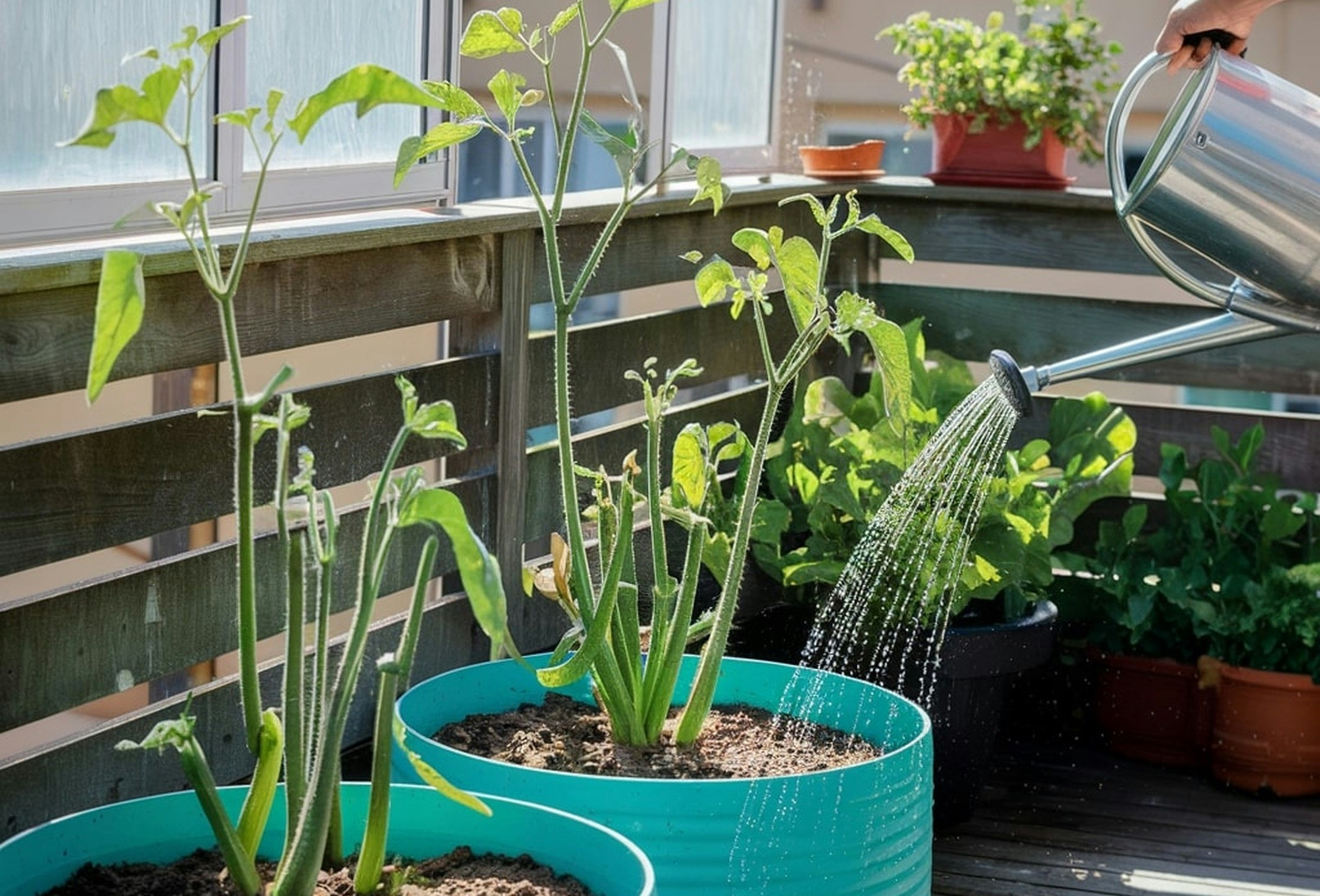
With limited beds for growing, there is still a lot that can be done in pots. They don’t have to cost a fortune either. Cheaper plastic ones can be bought from various places – or you can get imaginative and repurpose all manner of containers – just ensure to make small holes at the bottom, and line with broken crockery or small stones to help with drainage. I’ve used old washing up bowls, old recycling bins, items I’ve found in skips, buckets, food packaging, such as large margarine tubs; one thing I haven’t done, though I’ve heard this recommended, is growing potatoes in old wellies!
Don’t forget indoor windowsills, either – then even old crockery can be used, as it doesn’t need a draining hole at the bottom. A beautiful casserole pot that lost its lid makes a perfect, decorative pot for growing my basil in. There are plentiful ideas on the internet on how to use plastic bottles creatively for growing small plants in, too.
If you don’t have a greenhouse, then using pots to start seedlings off on your windowsills is a good idea – seeds germinate better, in the main, this way, and are less likely to be lost to birds, or to the vagaries of the British weather. Every spring, my windowsills are all covered with dozens, often hundreds of seedlings – to the dismay of my cats, who have to compete with them for the sunny spots.
Choose seeds and plants wisely
Look carefully on seed packets and plant labels to ensure that what you are choosing fits what growing space you have available. Pick carefully for sunnier or shadier spots, growth size, and whether they are suitable for pots.
With limited beds for growing, there is still a lot that can be done in pots.
Some things are better in pots: strawberries, particularly, I find, prefer being off the ground in pots as the slugs find it harder to eat all the delicious fruit. They propagate well each year – I use pegs to secure the baby plants into new pots. Don’t forget to water them, though! I started with six different strawberry plants from the garden centre, now I have over a hundred, in a vast array of pots.
Think also about nutritional value. A variety of types of fruit and vegetable is best for our optimum nutrition. Herbs too, although seeming so small, bring a vast amount of nutritional, even medicinal benefits – rosemary, for example, is great for countering inflammation and fungal infections, and even has some anti-cancer properties. Parsley is a nutritional powerhouse, and like many herbs, can even be grown on a sunny windowsill indoors.
Enjoy!
Gardening in this manner can’t provide all that we need. We can, however, use it to supplement other preparations – I have a store of rice, lentils, beans, and canned food, which I use in rotation so that items don’t go out of date. Clearing a cupboard or two to create a little store for hard times – I jokingly call it my 'siege preparations' – means that you can have a little more resilience, should it be needed.
Lastly, enjoy it. As well the delights of cooking and eating home grown food, and the benefits of eating fruit and vegetables with little pesticide and chemical use, gardening is good for us. Adam and Eve were first placed in a garden – and our bodies respond well to the plants and outdoor fresh air.
(Top image by Waleed Baloch on unsplash.com)
Kathryn Price, 18/02/2026