The San Remo Legacy
Reflecting on the impact of the British Mandate of Palestine
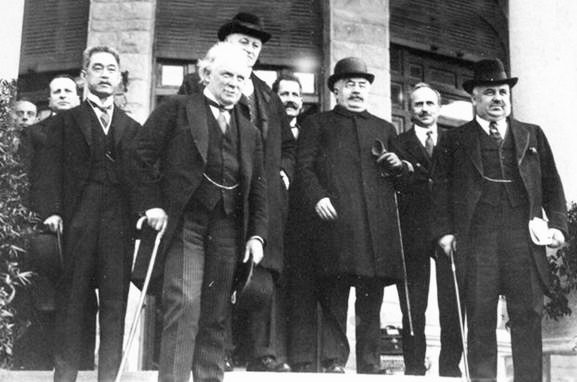 In reading the abundance of articles relating to Israel and the Palestinians, it really surprises me to see how few writers take into account the formative period in the history of the present day Middle Eastern nations in the wake of the First World War.
Carving up the land
The defeat of the Ottoman Empire in 1918 resulted in a complete carve up of the Middle Eastern area, creating new nations and giving oversight or mandatory control to Britain and France – the USA having opted out. France was given control of Syria and Lebanon while Britain was given the Mandate of Palestine. An important decision-making conference of international lawyers was held at San Remo in northern Italy in 1920. New nations, such as Saudi Arabia, Iran, Iraq, Jordan and Syria were created. Jordan was given the area of Palestine east of the River Jordan across to the borders of Iraq and the area of Palestine west of the River Jordan to the Mediterranean Sea was set aside for a homeland for the Jews.
This was ratified by the League of Nations and the Mandate for its creation and control was entrusted to Britain – but its terms were never fully detailed. It was left to Britain to negotiate with the Jews and Arabs. Churchill was put in charge of these negotiations and he met with huge hostility from the Arab nations who did not want any Jews in Palestine. As a result, there were widespread Arab riots in 1920 which the British army had to put down.
Room for Jews and Arabs
In June 1921, Churchill told the House of Commons; “There really is nothing for the Arabs to be frightened about… No Jew will be brought in beyond the number who can be provided for by the expanding welfare and development of the resources of the country.” In August, he repeated this to an Arab delegation in London, “I have told you again and again that the Jews will not be allowed to come into the country except insofar as they build up the means for their livelihood… They cannot take any man’s land. They cannot dispossess any man of his rights or his property… If they like to buy people’s land and people like to sell to them, and if they like to develop and cultivate regions now barren and make them fertile, then they have the right to do so.”
It was left to Britain to negotiate with the Jews and Arabs. Churchill was put in charge of these negotiations and he met with huge hostility from the Arab nations who did not want any Jews in Palestine.
There were very few Arabs living in the area of Palestine west of the Jordan in those days – most were Bedouins who were mobile families living in tents, and much of the land was owned by absentee Arab landlords living in other countries who were only too happy to sell their land. Churchill continued to tell the Arab delegation in London in 1921: “There is room for all. No one has harmed you… The Jews have a far more difficult task than you. You only have to enjoy your own possession; but they have to try to create out of the wilderness, out of the barren places, a livelihood for the people they bring in.”
The Zionist experiment
The entire population of Palestine in the early 20th century was less than half a million and most of the land was barren. The Encyclopaedia Britannica for the year 1900 says that there were less than 100 trees in the whole of Palestine. The British Government believed that the Jews would transform the land and bring prosperity to its occupants – both Arabs and Jews. Hence, they allowed a restricted number of Jews to enter Western Palestine in the 1920s, and they appointed an Arab king to rule over eastern Palestine, ignoring the Abrahamic covenant, and renamed it Jordan.
Western Palestine from the River Jordan to the Mediterranean Sea was the really difficult part that was emotion-laden with many complexities. Winston Churchill was personally committed to trying what he called ‘the Zionist experiment’ because he believed that only the Jews could transform the barren land of Palestine and make it prosperous for both Jews and Arabs. He told the British Parliament, “If left to themselves, in a thousand years the Arab population would never transform the barren land.” His problem was that the majority of Palestinians were from the Bedouin tribes who preferred anarchy to organised political government.
Churchill was personally committed to trying what he called ‘the Zionist experiment’ because he believed that only the Jews could transform the barren land of Palestine and make it prosperous for both Jews and Arabs.
Following the Cairo Conference that failed to produce an agreement between Arabs and Jews, Churchill told the Palestinian Arab delegation on 30th March 1921 that;
“It is manifestly right that the scattered Jews should have a national centre and a national home to be reunited and where else but in Palestine with which for 3,000 years they have been intimately and profoundly associated? We think it will be good for the world, good for the Jews, good for the British Empire, but also good for the Arabs who dwell in Palestine and we intend it to be so… They shall share in the benefits and progress of Zionism.”
Churchill believed that the persecution of Jews in Russia and other parts of Europe had created a problem for the entire world which the creation of a Jewish homeland in Palestine would solve. In a written note Churchill confirmed this;
“If, as may well happen, there should be created in our own lifetime by the banks of the Jordan, a Jewish state under the protection of the British Crown which might comprise three or four millions Jews, an event will have occurred in this history of the world which would from every point of view be beneficial and would be especially in harmony with the truest interests of the British Empire.”
A mandate partially unfulfilled
Sadly, Britain never did fulfil its obligations under the Mandate of Palestine to define the extent and control of Western Palestine and this is still the cause of friction today. The Jews believe they have a legal right to oversee the whole land west of the Jordan and to develop any barren land. That right was granted to them at San Remo in 1920 but was never fully implemented by Britain.
Britain never did fulfil its obligations under the Mandate of Palestine to define the extent and control of Western Palestine and this is still the cause of friction today.
It is time that Britain recognised its responsibility for the ongoing tensions in Palestine/Israel. We should be offering our apologies for our past failures and our help in ongoing disputes and negotiations towards final settlements of land issues in the region of Judea and Samaria - what is colloquially known as ‘The West Bank’.
A two-state solution would be totally against the policy the British Government was pursuing in 1920. If they had properly administered this policy at that time there would have been peace in Palestine today - as there is in those parts of Israel which have a majority Arab population, such as in Nazareth, where Arabs and Jews live peacefully together and Arabs take part in elections to the Knesset and play a full part in the life and economy of Israel.
(This article quotes from David Fromkin, ‘A Peace To End All Peace: The Fall of the Ottoman Empire and the Creation of the Modern Middle East’, Orion Publishing Group Limited, London, 2003.)
(image - Delegates to the San Remo conference in Italy, 25 April 1920)
Dr Clifford Hill, MA. BD. PhD, 12/03/2026