Antisemitism in the Church
Learning from the Jew-hating practices of Emperor Constantine
 Most Christians would not have been surprised to note that the man accused of stabbing Jews in London this week was born in Somalia.
Antisemitism from within
Many of us would be relieved to know that he was not British, so we can maintain our belief that Brits are nice to Jews. Some of us are content to blame all these foreigners coming into our country for the high level of anti-Semitism that is now coming to light – although the media in general goes out of its way to avoid any connection between Jew-hatred and Islam – despite it being contained in the teaching of the Qur’an, and having been prevalent throughout the history of that religion. The rest of us are quite happy to blame anyone for anti-Semitism: but certainly not ourselves!
Sadly, the truth is that the real culprit is the Church! Through our version of ‘Christianity’ we have moulded the culture of the British nation for centuries. All the churches of different denominations are guilty of gross anti-Semitism because it is built into the Christianity that we teach the clergy in our seminaries; certainly, I can testify that it was part of Church history that I was taught as an undergraduate as part of my training to preach the gospel!
Emperor’s Edicts
Anti-Semitism has been an integral part of Western Christianity since the Council of Nicaea in 325 A.D. Two edicts were passed at the end of the Council that were direct attacks upon Jews. They were formed by the Emperor Constantine (reigned 306–337 A.D.) who, through a trusted advisor, presided over the Council. He was determined to sever all connection between Christianity and Judaism because of his personal hatred of the Jews. Constantine framed Jews as a "detestable" and "depraved" people, primarily due to their rejection of Christ and the assertion that they were responsible for his death.
All the churches of different denominations are guilty of gross anti-Semitism because it is built into the Christianity that we teach the clergy in our seminaries ...
The Messianic Jewish faith of ‘The Way’ that the Jewish Messiah and His Jewish followers started was officially buried some 300 years after Pentecost, and the new religion of ‘Gentile Christianity’ arose. That new religion, which I refer to as the ‘Apostate Church of Western Christianity’, with its institutionalised anti-Semitism and its denial of its own historical and theological roots, was set to dominate the history and culture of Western nations for centuries to come.
The Dating of Easter
The dating of the crucifixion and resurrection of Jesus had always presented difficulties for Christians who wanted to honour the death and resurrection of Jesus that was at the heart of their faith. They knew that it took place at the time of Passover that began on the 14th of Nisan, but that was a movable feast that had to be determined each year by the rabbis who studied the phases of the moon.
Constantine, however, did not want to have any link with the Jewish authorities, whom he said, “have impiously defiled their hands with enormous sin, and are, therefore, deservedly afflicted with blindness of soul ... Let us then have nothing in common with the detestable Jewish crowd; for we have received from our Saviour a different way."
The emperor clearly overlooked the obvious fact that Jesus was a Jew. In his hatred of the Jewish people, he wanted to sever Christianity entirely from Judaism. He succeeded in gaining the support of a majority of the bishops at Nicaea who agreed to issue two statements:
Statement One
“First of all, it seemed most unworthy that in celebrating this most holy festival (The Crucifixion and Resurrection) we should follow the practice of the Jews, who have emphatically defiled their hands with enormous sin and are, therefore, deservedly afflicted with spiritual blindness. Since we have put aside their way of calculating the date of the festival, we can ensure that future generations can celebrate this observance at the more accurate time which we have kept from that first day when the passion occurred until the present time. Let us then have nothing in common with that detestable mass of Jews.”
In his hatred of the Jewish people, he wanted to sever Christianity entirely from Judaism.
Statement Two
“Let us with one accord adopt this course, and withdraw ourselves from that detestable association. For it is truly most absurd for them to boast that we are incapable of rightly observing these things without their instruction. For how should they be capable of forming a sound judgement, who, since their parricides are guilty in slaying their Lord, lost their senses, and are led not by any rational motive, but by ungoverned passion, and they are swayed by an uncontrollable impulsiveness from the mad spirit that is in them? …Why then should we follow those who are in serious error?”
Following the Council, Constantine wrote a letter to all the bishops and leaders of the Christian churches who had been unable to attend the Council. He read this to the Council before sending it so that it had behind it the full authority of the bishops.
The letter that Constantine read to the Council, addressed to those Bishops who were not present was:
"It was declared improper to follow the custom of the Jews in the celebration of this holy festival, because their hands having been stained with crime, the minds of these wretched men are necessarily blinded. ... Let us, then, have nothing in common with the Jews, who are our adversaries. ... Let us ... studiously avoid all contact with that evil way. ... For how can they entertain right views on any point who, after having compassed the death of the Lord, being out of their minds, are guided not by sound reason, but by an unrestrained passion, wherever their innate madness carries them. ... lest your pure minds should appear to share in the customs of a people so utterly depraved. ... Therefore, this irregularity must be corrected, in order that we may no more have anything in common with those parricides and murderers of our Lord."
The direction of Christianity away from its biblical foundations was established at Nicaea and confirmed at subsequent meetings. At the Council of Antioch in 345 A.D., Christians were banned from celebrating the Passover Seder (ritual meal) with Jewish friends or neighbours. Then at the Council of Laodicea in 363–4 AD, the biblical Sabbath day was outlawed in the following regulation:
“Christians must not Judaize by resting on the Sabbath, but must work on that day, rather honouring the Lord’s Day; and, if they can, resting then as Christians. But if any shall be found to be Judaizers, let them be cursed from Christ.” (Canon 29)
It was Luther’s teaching that undoubtedly formed a theological basis for the Nazi persecution of Jews and the murder of six million in the gas chambers.
By this time, all things Jewish were regarded as totally incompatible with Christianity. The new religion of ‘Western Gentile Christianity’ arose from the ashes of the discarded feasts, burnt in the flames of anti-Semitic hatred of the Jewish people that now became institutionalised in the Christian faith.
Luther’s legacy
This hatred of Jews was reaffirmed and reinforced by the teaching of Martin Luther centuries later, during the Reformation. Luther’s infamous publication in 1543 of ‘The Jews and Their Lies’ was a milestone in anti-Semitism and violence against Jewish people. He urged the German princes and nobles to drive Jews out of their provinces in order that “We may all be free of this insufferable devilish burden – the Jews.” He was using the same language as that of the Emperor Constantine at Nicaea more than a thousand years earlier. It was Luther’s teaching that undoubtedly formed a theological basis for the Nazi persecution of Jews and the murder of six million in the gas chambers.
Western Christianity has much need of coming weeping before the Lord – renouncing the teaching of the Council of Nicaea in 325 A.D. and begging forgiveness from our brothers and sisters – the Jews. If we have any doubts on this subject we should ask ourselves the theological question: ‘Why did God choose the Jews to be the people among whom He would send his Incarnate Son?’
Cultural shift
In reports of the stabbings in Golders Green London this week there have been calls for a change of culture in Britain rather than simply increasing security - Metropolitan Police Commissioner Sir Mark Rowley highlighting that the responsibility for tackling antisemitism extends beyond the police, implying a need for a broader societal or cultural shift.
I believe the churches should lead such a change of culture by reaffirming the biblical teaching on the central importance of the people of Israel in the purposes of God; and the unity of Jew and Gentile in the teaching and practice of the Early Church in the first three centuries of church history which reflected the teaching of Jesus.
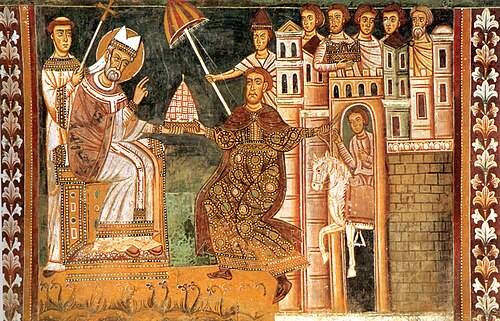
(image - Emperor Constantine and Pope Sylvester)
Rev Dr Clifford Hill (MA. BD. PhD), 01/05/2026