A Pattern for Renewal 3: Order in the House of God
A study of 2 Chronicles 31
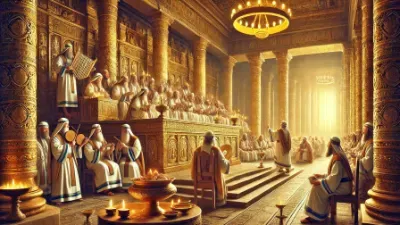 Nick Thompson has written a four-part mini-series study on 2 Chronicles - A Pattern for Renewal - beginning with a consideration of chapter 29, Hezekiah’s restoration of Temple worship, and following with chapter 30, the Passover. This week he takes a closer look at chapter 31.
In 2 Chronicles 31, King Hezekiah continues his sweeping reforms following the great Passover celebration described in the previous chapter. While chapter 30 emphasises worship and unity, chapter 31 focuses on structure and sustainability; two elements crucial for long-term revival. This chapter reveals a mature and spiritually discerning king who not only initiates revival but organises and institutionalises it for the health of Judah’s covenantal life.
We can see how Hezekiah’s reforms align closely with the divine patterns of Torah’s framework for Israelite society. Additionally, understanding divine order and sacred space helps us to recognise Hezekiah’s actions as reasserting YHWH’s dominion through sacred bureaucracy. This chapter illustrates that faithful administration of worship is itself an act of worship.
Continuing the Reformation (2 Chronicles 31:1)
“Now when all this [worship and celebration] was finished, all Israel who were present went out to the cities of Judah and broke in pieces the pillars... and cut down the Asherim and broke down the high places... until they had destroyed them all.” (v. 1)
True worship compels transformation.
True worship compels transformation. After the Passover, the people are moved to action. They dismantle the infrastructure of idolatry, not only in Judah but also in Ephraim and Manasseh, a significant reach into the northern territories.
I understand this as the Israelites acting as covenant enforcers, aligning themselves with the Deuteronomic mandates to destroy pagan sites (cf. Deuteronomy 12:2-3).
Life Application: A heart awakened in worship does not tolerate compromise. Genuine revival results in the destruction of idols and the elevation of God’s Word as supreme.
Reinstituting the Priestly Orders (vv. 2-3)
“And Hezekiah appointed the divisions of the priests and of the Levites... each according to his service... to give thanks and praise and to minister in the gates of the camp of YHWH.” (v. 2)
Hezekiah reinstitutes the Levitical divisions originally set up by David and Solomon (cf. 1 Chronicles 23-26). Order in the priesthood means that worship is continuous, deliberate, and guarded.
“The king contributed from his own possessions for the morning and evening burnt offerings...” (v. 3)
Hezekiah leads by example, financially supporting the daily offerings. The king assumes personal responsibility for covenant maintenance, echoing the role of a righteous Israelite king (Deuteronomy 17:18-20).
There is a very real and significant hint in the text that temple rituals maintain sacred space.
There is a very real and significant hint in the text that temple rituals maintain sacred space. They do so by keeping it in a state of purity to allow for divine presence.
Life Application: Leadership in worship means personal investment. Leaders set the tone when they prioritise and finance sacred duties.
Reviving Torah-Based Giving (vv. 4-7)
“He commanded the people... to give the portion due to the priests and the Levites, that they might give themselves to the Torah of YHWH” (v. 4)
Hezekiah re-establishes tithing to support the priesthood. This is deeply Torah-rooted (cf. Numbers 18:21-24). Without proper provision, the Levites could not fulfil their sacred duties.
“As soon as the command was spread abroad, the people of Israel gave in abundance...” (v. 5)
The people’s response is enthusiastic and sacrificial. They bring the firstfruits and tithes of all produce, livestock, and goods.
The thing that invariably strikes me in the Bible is where we see the joy and community of Torah observance, such as in this instance. Tithing is not just an obligation; it is participation in the national covenant.
“They laid them in heaps... from the third month to the seventh month.” (vv. 6–7)
The generosity is so abundant that it results in excess.
The generosity is so abundant that it results in excess. Months-long collections indicate both the richness of the land and the readiness of the people to support the priestly work.
Life Application: When spiritual priorities are in order, material provision follows. God’s people should give joyfully and abundantly to sustain the work of ministry (cf. 2 Corinthians 9:6-8).
Administration and Oversight (vv. 8-10)
“When Hezekiah and the princes came and saw the heaps, they blessed YHWH and His people Israel.” (v. 8)
Seeing the heaps of provision inspires gratitude. But good leadership doesn’t stop at gratitude; it ensures that abundance is managed wisely.
“Azariah the chief priest... said, ‘Since they began to bring the contributions... we have eaten and had enough and have plenty left.’” (v. 10)
The priests testify to God’s blessing. There is sufficiency and surplus. God honours order, generosity, and worship. This links directly to the Edenic principle: where God reigns, abundance flows. Hezekiah’s reforms are returning Judah to a state of divine favour.
Financial stewardship in ministry is spiritual stewardship.
Life Application: Financial stewardship in ministry is spiritual stewardship. Order honours God and benefits people.
Appointing Overseers for Distribution (vv. 11-19)
Hezekiah doesn’t leave distribution to chance. He appoints storehouses and capable men to oversee the resources:
“Hezekiah commanded them to prepare chambers in the house of YHWH ... and they faithfully brought in the contributions.” (vv. 11-12)
Several men are named – Kore, Conaniah, Shimei, and others – entrusted with managing resources. They are called “faithful” (v. 15).
“They distributed to their brothers by divisions, old and young alike, by genealogies...” (vv. 15-19)
Distribution is equitable and organised. Everyone receives according to their station and responsibility. Genealogical records ensure rightful inheritance and service.
Reading this passage is akin to watching covenantal justice in action. Fair and transparent distribution of sacred resources upholds the Torah’s vision of community.
Life Application: The integrity of God’s house includes transparent administration. Faithfulness in small things sustains long-term revival (Luke 16:10).
Summary of Hezekiah’s Faithfulness (v. 20-21)
“Hezekiah did what was good and right and faithful before YHWH his God. And every work that he undertook in the service of the house of God... he did with all his heart, and prospered.” (vv. 20-21)
Wholehearted devotion in spiritual leadership brings prosperity, not just materially, but relationally, communally, and spiritually.
The Chronicler’s summation is glowing. Hezekiah is portrayed as a model of faithful kingship. His devotion is not partial, it is wholehearted. There is an unspoken cross-reference to Deuteronomy 6:5 in this, the idea of loving God with all one’s heart. Hezekiah embodies the Shema in his leadership. Hezekiah’s actions are reasserting sacred order against cosmic chaos. Where idols once ruled, YHWH now reigns through faithful human stewardship.
Life Application: Wholehearted devotion in spiritual leadership brings prosperity, not just materially, but relationally, communally, and spiritually.
Conclusion
2 Chronicles 31 shows us that revival – and good God-centred community – must be structured. Hezekiah’s reforms are not merely emotional responses to a festival; they are systemic, administrative, and spiritual. He ensures that worship, tithing, priestly service, and communal distribution are restored according to Torah.
These actions are deeply covenantal, with cosmic and spiritual implications. Hezekiah is not just managing a nation; he is restoring the kingdom of God within Judah.
In our own communities, this chapter challenges us to move beyond moments of inspiration to lives of organisation, order, and generosity. Revival, to be sustained, must be structured. And when it is, God’s blessing flows.
Nick Thompson, 21/05/2026